

How to Use Hedy for Sales Calls
Get real-time coaching during sales calls and discovery meetings, then a full write-up afterward. This guide walks you through how to set up and get the most out of Hedy’s Sales Meeting session type. It is built for the person doing the selling, and it stays private to you.
Step 1: Select the Sales Meeting Session Type
Before your call, make sure Hedy is in the right mode:
-
Open Settings and go to the Sessions tab
-
Select Sales Meeting as your session type
This switches Hedy into sales mode. Every suggestion, summary, and the detailed notes will be tailored for selling.
New to Hedy? You can also pick Sales calls during onboarding, and Hedy starts you off in this session type.
Step 2: Put What You Sell in the Session Context
This is the reusable half of your setup. Tap Session Context and give Hedy the things that stay true across every deal. Save it as a custom context once and every sales call, with every prospect, starts from it.
Here is what belongs in it:
What you sell
A short description of your product and the problem it solves. “We sell a scheduling tool that cuts no-shows for clinics” is much better than “software.”
Your pricing
The number and how it is framed (per seat, per location, per month), so Hedy can help you state it with confidence when it comes up.
What you sell against
The competitors and status-quo tools you face most often, so Hedy can help you position when one comes up.
Example session context: “We sell an AI scheduling tool that reduces patient no-shows for dental clinics. Typical plan is $300/month per location. We usually sell against generic calendar tools, and against practice-management suites at larger practices.”
Notice what is missing: the prospect and the deal. Those change with every account, so they live one level up, in the topic.
Step 3: Create a Topic for Each Deal
Everything specific to one account goes into a topic:
-
Create a topic named after the account
-
Add every call with them to it: the discovery call, the demo, the pricing conversation, the follow-ups
-
Open the topic, tap Edit, and put the deal specifics into the context field
That last part is Topic Context, and it applies automatically to every call inside the topic. Include who you are meeting and their role, whether they are the decision-maker, where the deal stands, what they currently use, and your goal for the next call. Update it as the deal moves; your session context underneath stays untouched.
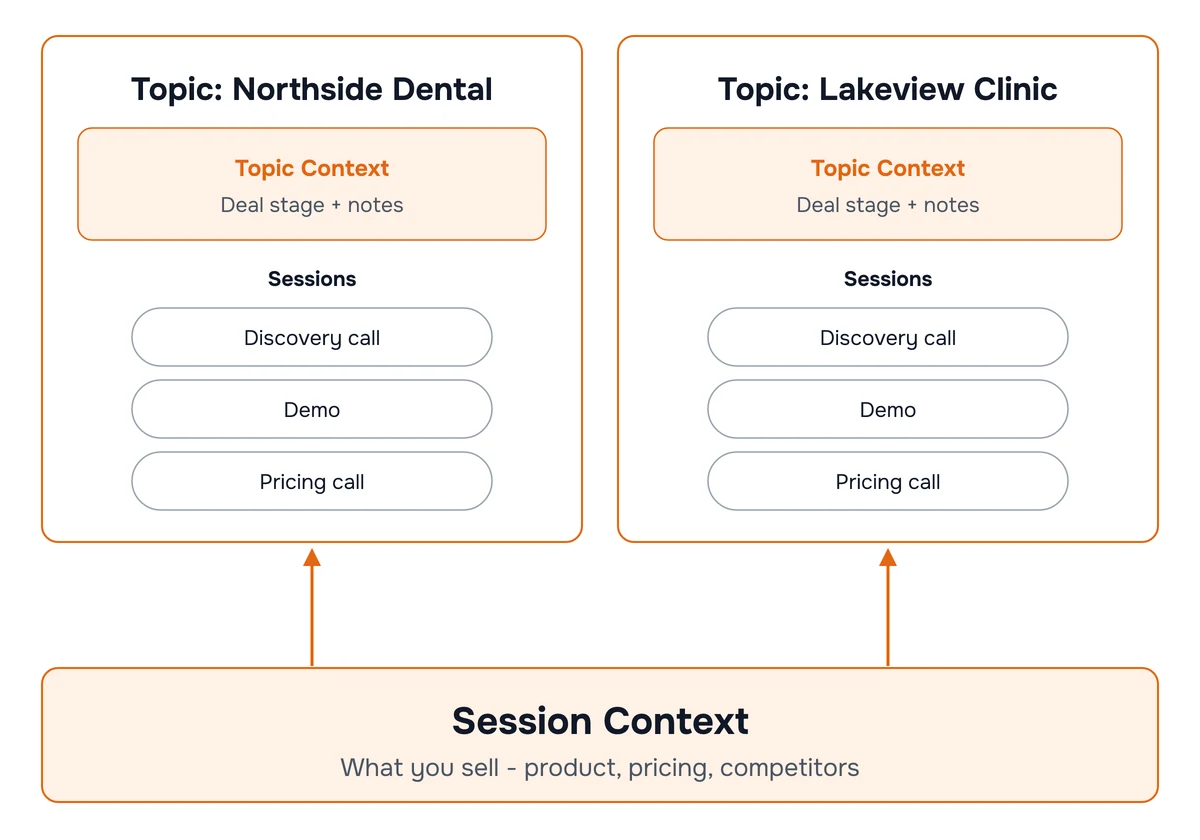
Example topic context: “4-location dental practice, found us through a webinar. Discovery done with the office manager: confirmed no-shows are costing them real money. Decision-maker is the practice owner, not yet met. They use a generic calendar tool today. Goal for the next call: book a demo with their ops lead.”
Grouping the calls this way also lets Hedy surface trends across them: recurring objections, buying signals that repeat, and what you still have not confirmed.
Free accounts include one topic, which covers one active deal. Pro accounts have unlimited topics, one per account in your pipeline.
Step 4: Start Your Call
Hit start and sell naturally. Hedy works in the background, so you do not need to do anything special.
Automatic suggestions appear on their own as the conversation unfolds. Glance down when you have a moment. They show up at the moments that matter most on a sales call:
-
Discovery gaps when you are moving toward a pitch without having confirmed the problem, the decision-maker, or the timeline
-
Unanswered objections when a concern was raised and the conversation moved on without addressing it
-
Buying signals when the prospect says something that shows real interest
-
Pricing moments when the number comes up and you need to frame it with confidence
-
Competitor mentions when they name an alternative and you can position against it
-
Talk-ratio nudges when you have been talking a while without asking a question
-
A next-step reminder as the call winds down if nothing concrete has been agreed
Quick Actions You Can Tap Anytime
When you want specific help during the call, tap a quick action. The full list is in the Sales Meeting Quick Prompts reference. There are six categories:
Run Discovery
-
Get the next open question that gets past surface facts to the real problem
-
Check whether you are talking too much and hand the floor back
-
See what you have not confirmed yet, and the hardest question you are avoiding
Quantify the Pain
-
Make the cost of the problem concrete
-
Get the prospect to describe the value of solving it in their own words
-
Find out whether there is any urgency to act now
Handle an Objection
-
Acknowledge the concern and explore it before you respond
-
Lower the tension when a conversation gets tense
-
Tell whether an objection is real or a polite brush-off
Talk Pricing
-
State the price once, confidently, anchored to value
-
Reframe a price pushback to total cost instead of discounting
-
Connect the price to the value the prospect described
Position vs a Competitor
-
Surface the one differentiator that matters to this prospect
-
Find what is not working with their current tool
-
Steer the comparison onto the ground where you are strongest
Lock the Next Step
-
Propose a specific, dated next step and get it on the calendar
-
Check whether a next step was actually agreed
-
Find out who else needs to be involved
The Methodologies Behind the Coaching
Hedy’s sales coaching is grounded in established selling craft, so the suggestions hold up. You never need to know any of these by name, because Hedy keeps the language plain and just helps you in the moment.
-
SPIN-style discovery shapes the questions Hedy suggests, moving from the situation to the problem, to its impact, to the value of solving it, so the prospect talks themselves into the change.
-
Qualification tracking keeps an eye on what you still need to confirm to know the deal is real: the impact of the problem, who the decision-maker is, how the decision gets made, and the timeline.
-
Objection handling follows listen, acknowledge, explore, then respond, plus labeling to lower tension, so you address the real concern instead of getting defensive or discounting on reflex.
Step 5: Review Your Results
After your call, Hedy generates two outputs tailored for selling:
Session Summary (Recap)
-
Summary of what happened, scaled to the length of the call
-
Key points tagged so you can scan them: the pain uncovered, what you qualified, objections raised, competitors mentioned, buying signals, and any risks
-
Action items to move the deal forward
-
Your to-dos, including the agreed next step, with a reminder to set one if the call ended without it
Detailed Notes
A complete record of the call with dedicated sections for:
-
Call Scorecard with your talk-to-listen ratio, your longest monologue, how many questions you asked, and whether a next step was set
-
Qualification covering what you confirmed and what is still open
-
Pain & Impact, the problem the prospect described and what it costs them
-
Objections & How Handled, each concern raised and how it was addressed
-
Buying Signals and Competitors mentioned on the call
-
Stakeholders, who is involved in the decision
-
Commitments & Next Steps, what was agreed and by when
-
Suggested Follow-up Email, a ready-to-send draft you can adapt and send
What Hedy Will Never Do
-
Grade you for a manager. Sales Meeting is your private coach, not a team dashboard or a monitoring tool. Your calls stay yours.
-
Need a CRM. There is nothing to connect or set up. Hedy works from your call and the context you give it.
-
Push you to discount. When price comes up, Hedy helps you frame value and hold your number, not cave on it.
-
Decide the deal for you. Hedy helps you ask, qualify, and position. The judgment is always yours.
Tips for Best Results
-
Context is everything. What you sell lives in the session context; the deal lives in the topic. Together they are the difference between coaching aimed at this deal and generic sales advice.
-
Update the topic context between calls. Move the deal stage forward, add the stakeholders you met, and note the objections that came up, so the next call’s coaching starts where the last one ended.
-
Use the scorecard to improve. The talk ratio, monologue length, and question count give you an honest read on your own calls over time.
-
Stay present. Hedy’s suggestions will be there when you glance down. Do not read during a critical moment. Stay engaged with the prospect.
Pro tip: Use the detailed notes and the follow-up email draft to send your recap while the call is fresh. A fast, specific follow-up that restates the agreed next step is one of the simplest ways to keep a deal moving.